


From Creation (Genesis 1:27) to New Creation (Galatians 3:28), Scripture tells the story of a God who creates men and women in God’s image. Full stop. No exceptions. No exclusions.
Scripture is never written, read, or interpreted in a vacuum, though.
From as early as people began telling the story of God’s work in the world, men’s and women’s callings have been mediated through social stories, cultural practices, personal preferences, and institutional norms that both constrain and expand how they imagine God might use them in ministry. Those discerning ministry paths are shaped by voices both inner and external. Those in the thick of ministry come against limits both real and imagined. And those who mentor ministers-in-training learn to root their guidance in both the realities of this world and the possibilities of a future grasped only in glimpses.
In a new resource from the Duke Clergy Health Collaborative, One Source, Different Paths, we seek to explore women’s call to ministry in The United Methodist Church by bringing current gender realities to the surface and getting curious about what these trends may be revealing. To do so, we draw on two complementary sources of evidence: national United Methodist clergy appointment records from 2000-2021, as well as surveys and interviews with over 500 entering Master of Divinity students who participated in our Seminary to Early Ministry (SEM) Study. Together, these data sets show that gender disparities in congregational leadership emerge not only through barriers women encounter after entering ministry, but also earlier through the ways they learn to imagine, discern, and pursue different forms of ministry.1
In other words, it's not only an institutional “stained-glass ceiling” keeping women from certain leadership roles in the church, but also a personal “strained-fit feeling.”
What do we mean by a “strained-fit feeling”?
Across all professions, men and women enter professional pathways with aspirations, preferences, and work-related values which have already been filtered through gendered cultural expectations and experiences. This leads to gender-typical career choices—not just career barriers—at key decision-making junctures.
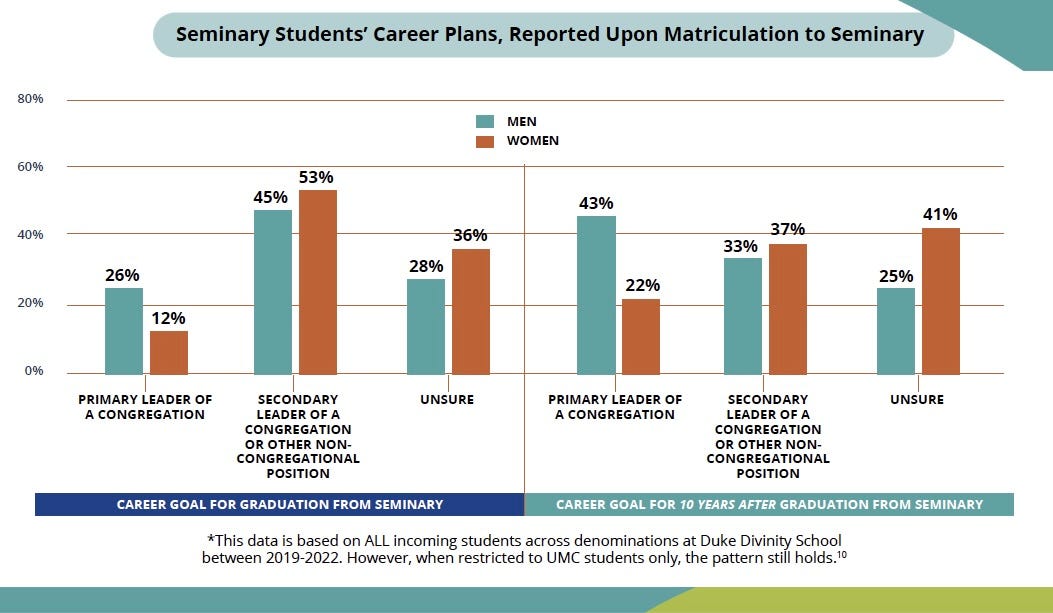
For example, in our SEM study, we interviewed students right as they started seminary. We found that between 2019-2022, incoming male students were twice as likely as women (26% v. 12%) to aspire to be the primary leader of a congregation upon graduation, a trend which held true when asked about their plans and expectations for 10 years after graduation. Note that this data indicates a perception of fit before most students have come up against the realities of the role.
In our interviews with first-year seminary students who were women, the following explanations were given for these early preferences…
…on what expands or constrains vocational imagination:
Messages about who can lead
Presence or absence of role models
Encouragement from mentors, faculty, family, and denominational authorities
Perceptions of one’s skills, gifts, and fit
…on what pulls women toward particular ministries:
Relational and specialized work
Justice and community engagement
Perception of where ministry is most effective
Occupational flexibility
A desire to connect church and world
Alignment with values and vocational identity
Alignment with socialized gender norms
…on what pushes women away from primary congregational leadership:
Anticipated or experienced sexism and resistance
Narrow images of pastoral leadership
Perceptions about the effectiveness of congregational ministry as a locus for change in the world
Concerns about authority, authenticity, and safety
Itinerancy and its effects on relationships, family, and stability
Negative congregational or internship experiences
Lack of confidence developed within gendered environments
Even as mainline traditions like The United Methodist Church stand on the forefront of the movement toward women’s full authority in the church, gendered preferences, barriers, and gaps remain amongst their leaders. One seminary student put it plainly, “You’re fighting an extra battle as a female trying to be a pastor of a church. And that can be a battle that can be fought, but it’s like, do you want to do that?”
So, where do we go from here?
Gender disparities are produced and re-produced not only when women are denied opportunities, but also much earlier, as they imagine which opportunities might be desirable, safe, and appropriate for them.
Whatever your gender, if you are a candidate for ministry or already a clergyperson, here are some closing questions (excerpted from our One Source, Many Paths resource) to help you consider your own call to ministry, reflect on the ways that gender continues to shape your vocation, and encourage you to consider the ongoing role you play in raising up the next generation of leaders to serve God.
Regardless of your gender, where do you see your own story reflected in this data?
How did ministry first become imaginable to you? What pathways of ministry seemed possible?
What barriers have you encountered on your ministry path? Which were real and which were assumed?
If you could revisit your earliest discernment conversations, what would you want your younger self to hear? Is there anyone in your life who might need to hear that now?
Your Serve Well Resource
One Source, Different Paths: How Does Gender Shape the Call to Ministry?
Whether you’re discerning ministry, in the thick of ministry, or mentoring others in ministry, this resource helps you unpack the data on how gender disparities in congregational leadership emerge and invites you to reflect on a more expansive way forward.
After reading it, consider sharing it with a younger person weighing ministry and invite them to discuss it over coffee. Or share it with a supervisor in ministry and invite them to discuss over tea. Or gather a cohort of other ministry leaders and facilitate a courageous conversation on how gender is still shaping your vocational imagination. How can you encourage one another to listen more deeply and freely?
One Source, Different Paths expands the Duke Clergy Health Collaborative’s library of resources to support sexual and gender minorities in ministry. If you find it helpful, be sure to tell a friend. All resources are available for free on our website.
This research specifically addresses the experience of women in ministry. The experience of non-binary clergy is beyond the scope of this work. We also acknowledge that gender is not the only factor that impacts experiences of vocation, and that age, race, ethnicity, and sexual orientation also have intersectional impacts on chosen career pathways. While this research doesn’t address those impacts specifically, we acknowledge their presence as part of this conversation.
Great read. I have considered this topic in my professional career (advertising) but hadn't crossed my mind for congregations. It's fascinating to see the variance of goals between genders before a person has started training.